World's Largest English Language News Service with Over 500
Articles Updated Daily
"The News You Need Today…For The World You’ll Live In Tomorrow."
What You Aren’t
Being Told About The World You Live In
How The “Conspiracy Theory” Label Was Conceived To Derail The
Truth Movement
How Covert American Agents Infiltrate the Internet to Manipulate, Deceive and Destroy Reputations
April 8, 2026
Trump Proclaims “Big Day For
World Peace” After
By: Sorcha Faal,
and as reported to her Western Subscribers
An enlightening new Security Council (SC) report circulating in the Kremlin today first notes President Donald Trump posted the announcement at 6:32 PM last evening: “Based on conversations with Prime Minister Shehbaz Sharif and Field Marshal Asim Munir, of Pakistan, and wherein they requested that I hold off the destructive force being sent tonight to Iran, and subject to the Islamic Republic of Iran agreeing to the COMPLETE, IMMEDIATE, and SAFE OPENING of the Strait of Hormuz, I agree to suspend the bombing and attack of Iran for a period of two weeks...This will be a double sided CEASEFIRE!...We received a 10 point proposal from Iran, and believe it is a workable basis on which to negotiate...Almost all of the various points of past contention have been agreed to between the United States and Iran, but a two week period will allow the Agreement to be finalized and consummated”.
Quickly following President Trump announcing: “We received a 10 point proposal from Iran, and believe it is a workable basis on which to negotiate...Almost all of the various points of past contention have been agreed to between the United States and Iran”, this report notes, the Supreme National Security Council of the Islamic Republic of Iran declared:
The
No new aggression against
Continued Iranian control
over the
Acceptance of enrichment
Removal of all primary
sanctions
Removal of all secondary
sanctions
Termination of all UN
Security Council resolutions
Termination of all Board of
Governors resolutions
Payment of compensation to
Withdrawal of US combat
forces from the region
Cessation of war on all
fronts, including against the heroic Islamic Resistance of Lebanon
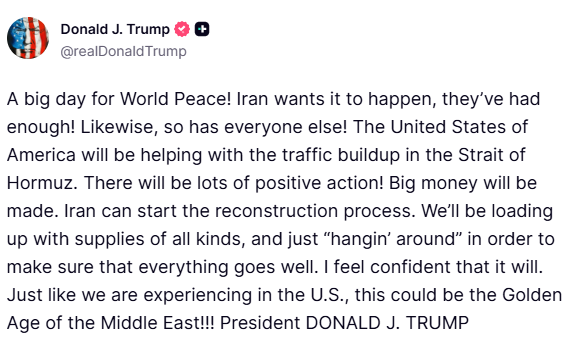
After Iran declared its “historic victory” over the United States, this report continues, President Trump, at 12:01 AM early this morning, posted the proclamation: “A big day for World Peace!...Iran wants it to happen, they’ve had enough!...Likewise, so has everyone else!...The United States of America will be helping with the traffic buildup in the Strait of Hormuz...There will be lots of positive action!...Big money will be made...Iran can start the reconstruction process...We’ll be loading up with supplies of all kinds, and just “hangin’ around” in order to make sure that everything goes well...I feel confident that it will...Just like we are experiencing in the U.S., this could be the Golden Age of the Middle East!!!”.
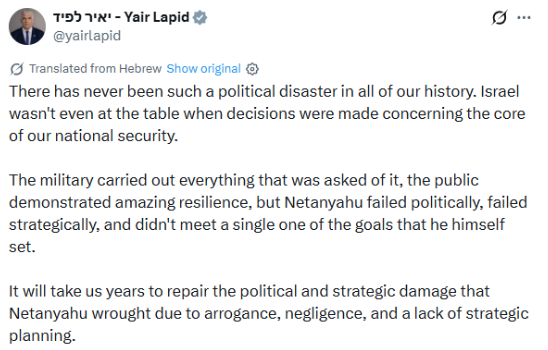
According to Israeli media sources today, this report details, Prime Minister Benjamin Netanyahu warned President Trump on Sunday against agreeing to a ceasefire with Iran and told a cabinet meeting that in the event of a ceasefire with Iran, Jerusalem would not be required to halt its operations against Hezbollah in Lebanon—and after President Trump announced the ceasefire last evening based on the 10 point plan offered by Iran, it saw top Israeli opposition leader Yair Lapid raging: “There has never been such a political disaster in all of our history...Israel wasn't even at the table when decisions were made concerning the core of our national security...The military carried out everything that was asked of it, the public demonstrated amazing resilience, but Netanyahu failed politically, failed strategically, and didn't meet a single one of the goals that he himself set...It will take us years to repair the political and strategic damage that Netanyahu wrought due to arrogance, negligence, and a lack of strategic planning”.
As to who is responsible for the greatest political disaster in Israeli history, this report notes, the New York Times, in its just released intelligence article “How Trump Took The U.S. To War With Iran”, based solely on information provided by Trump administration officials, revealed:
In the Situation Room on Feb. 11, Mr. Netanyahu
made a hard sell, suggesting that
At one point, the Israelis
played for Mr. Trump a brief video that included a montage of potential new
leaders who could take over the country if the hard-line government fell. Among those featured was Reza Pahlavi, the
exiled son of
Mr. Netanyahu and his team outlined conditions
they portrayed as pointing to near-certain victory:
Mr. Netanyahu delivered his
presentation in a confident monotone. It
seemed to land well with the most important person in the room, the American
president.
Sounds good to me, Mr. Trump told the prime
minister. To Mr. Netanyahu, this
signaled a likely green light for a joint U.S.-Israeli operation.
Mr. Netanyahu’s
presentations — and Mr. Trump’s positive response to them — created an urgent
task for the
‘Farcical’
The results of the
The intelligence officials
had deep expertise in
The
When Mr. Trump joined the
meeting, Mr. Ratcliffe briefed him on the assessment. The C.I.A. director used one word to describe
the Israeli prime minister’s regime change scenarios: “farcical”.
At that point, Mr. Rubio
cut in. “In other words, it’s
bullshit”, he said.
Mr. Ratcliffe added that
given the unpredictability of events in any conflict, regime change could
happen, but it should not be considered an achievable objective.
Several others jumped in,
including Mr. Vance, just back from
The president then turned
to General Caine. “General,
what do you think?”
General Caine
replied: “Sir, this is, in my experience, standard
operating procedure for the Israelis. They
oversell, and their plans are not always well-developed. They know they need us, and that’s why
they’re hard-selling”.
As the small team of
advisers who were looped into the plans deliberated over the following days,
General Caine shared with Mr. Trump and others the alarming military assessment that a major campaign against
He also flagged the
enormous difficulty of securing the Strait of Hormuz and the risks of
General Caine’s
role in the lead-up to the war captured a classic tension between military
counsel and presidential decision-making.
So persistent was the chairman in not taking a stand — repeating that it
was not his role to tell the president what to do, but rather to present
options along with potential risks and possible second- and third-order
consequences — that he could appear to some of those listening to be arguing
all sides of an issue simultaneously.
He would constantly ask, “And then what?” But Mr. Trump would
often seem to hear only what he wanted to hear.
Vance the Skeptic
Nobody in Mr. Trump’s inner
circle was more worried about the prospect of war with
The vice president thought a regime-change war
with
But knowing that Mr. Trump
was likely to intervene in some fashion, he tried to steer toward more limited
action. Later, when it seemed certain
that the president was set on a large-scale campaign,
Mr. Vance argued that he should do so with overwhelming force, in the hope of
achieving his objectives quickly.
In front of his colleagues, Mr. Vance warned Mr.
Trump that a war against
Mr. Vance raised other
concerns, too. As vice president, he was
aware of the scope of
The vice president told associates that no amount
of military insight could truly gauge what
Moreover, he thought there
seemed to be little chance of building a peaceful
The “unpredictable directions” that Vice President J.D. Vance warned a war on Iran would take, this report concludes, now includes the greatest political disaster in Israeli history and a Strait of Hormuz global economic catastrophe—and with more than 800 vessels remaining trapped in the Persian Gulf after the Strait of Hormuz was virtually closed following the United States and Israeli strikes on Iran in late February, it caused top Kremlin envoy Kirill Dmitriev to warningly assess today: “Global energy markets will take months to recover from the shock caused by the US Israeli war on Iran”.
[Note: Some words and/or phrases appearing in quotes in this report are English language approximations of Russian words/phrases having no exact counterpart.]
April 8, 2026 © EU and US all rights reserved.
Permission to use this report in its entirety is granted under the condition it
is linked to its original source at WhatDoesItMean.Com. Freebase content
licensed under CC-BY
and GFDL.
[Note:
Many governments and their intelligence services actively campaign against the
information found in these reports so as not to alarm their citizens about the many catastrophic Earth changes and
events to come, a stance that the Sisters of Sorcha Faal
strongly disagree with in believing that it is every human being’s right to
know the truth. Due to our mission’s conflicts with that of those governments,
the responses of their ‘agents’ has been a longstanding
misinformation/misdirection campaign designed to discredit us, and others like
us, that is exampled in numerous places, including HERE.]
[Note:
The WhatDoesItMean.com website was created for and donated
to the Sisters of Sorcha Faal in 2003 by a small group of American computer
experts led by the late global technology guru Wayne Green (1922-2013) to
counter the propaganda being used by the West to promote their illegal 2003
invasion of Iraq.]
[Note:
The word Kremlin (fortress inside a city) as used in
this report refers to Russian citadels, including in
The
Greatest Show On Earth Directed By Trump Nears Final
Act
Iran
War Enters Comet And Crows Phase Of Doom