World's Largest English Language News Service with Over 500
Articles Updated Daily
"The News You Need Today…For The World You’ll Live In Tomorrow."
Note:
This is an urgent private letter intended for the sole and exclusive use of the
patron/donors to the Sisters of Sorcha Faal.
29 June 2026
Western World Tumbles Into Abyss While Dividing Hide Of Uncaptured Bear
Hello Folks,
The entire Western propaganda media establishment is focused today on
the United States-Iranagreement to stop attacking each other
and restart negotiations tomorrow, but they are completely ignoring the monumental and age defining speechPresident
Putin delivered to the United Russia Party Congress in Moscow
yesterday.
“We have the capabilities, the plan,
we know what needs to be done”.With these words,
spoken at the “LandEuro” conference in Germany, U.S.
Army Europe and Africa Commander General Christopher Donahue did more than just
outline military readiness.
He issued a deliberate and unmistakable message
aimed far beyond the audience in the room.
His pointed remarks about
being able to “wipe out” Russia’s
A2AD (Anti-Access/Area Denial) capabilities in Kaliningrad were not offhand bravado — they
were a calculated signal, deeply rooted in strategy, deterrence, and alliance
cohesion.
Kaliningrad, a heavily militarized Russian
exclave wedged between NATO members Lithuania
and Poland, has long been
considered a flashpoint and a potential hub for Russia’s A2AD systems — including
advanced air defense systems like the S-400, Iskander missile complexes, and
electronic warfare assets.These
capabilities are designed to deter or delay NATO action in a conflict by
controlling air and sea access in the region.
By declaring that U.S. and
allied forces could neutralize these assets quickly and effectively, Gen.
Donahue sent a message that NATO not only understands the threat, but has
prepared specifically to counter it — a direct
challenge to the Kremlin’s confidence in Kaliningrad’s defensive umbrella.
At the same time President Trump ousted General Donovan for
directly challenging Russia, world-renowned American
international relations theorist Professor
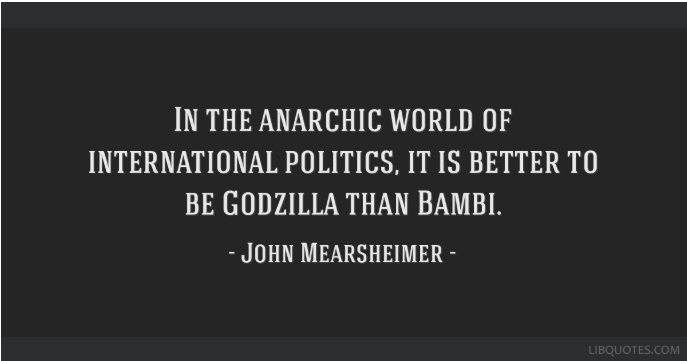
John Mearsheimer at the University of Chicago, in the video “Russia's Message to Europe, The Gloves Are Coming Off”,
warned about the abyss the Western world is tumbling into.
“Russia is finished”, cheerfully proclaimed The Atlantic
on its May 2001 cover.
The headline was wrong, but it proved to be really
catchy.It has been echoed for over two decades
by a host of experts, academics, and writers, with regular frequency.
All the while, Russia,
spiteful as ever, does not heed the experts’ opinions and does not seem to be
collapsing anytime soon.
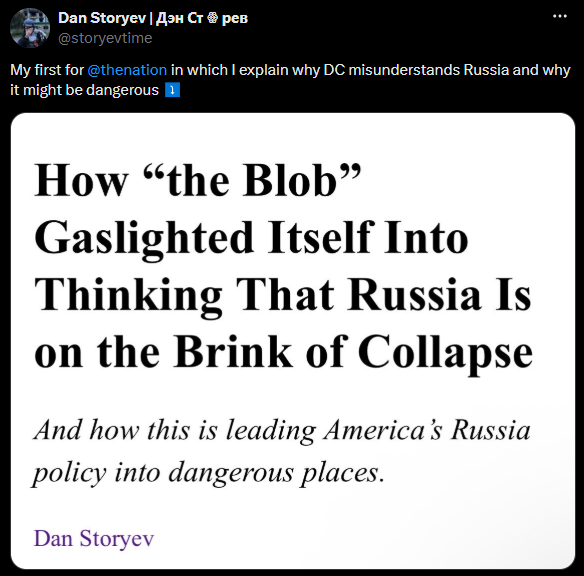
Instead, if anything is collapsing today, it is America’s ability to understand Russia, which
was never great to begin with.
The self-delusion of the
foreign-policy “Blob”, coupled with the anti-intellectualism of the second
Trump administration, joined by wartime cancel culture, and accompanied by
dishonest sources—all created a cocktail of groupthink that posits that Russia is on
the brink of collapse.
This cocktail is poison to Washington’s policy vis-à-vis Russia and Russians.It already led to wasteful spending,
misguided diplomacy, and even attacks on free speech on US soil.
The sanctions did not
manage to permanently reduce “the ruble to rubble”, as then-President Biden
prematurely boasted.The combined might
of the United States and its
allies could not isolate “collapsing” Russia from the rest of the world.
In the meantime, voices
that could offer a more rational explanation of Russia to the public and
policymakers are shunned.Even the most
anti-Putin Russian intellectuals are canceled in American forums, while experts
who try to argue for more nuance in America’s approach to Russia are branded as Kremlin
stooges by the commentariat.
Some of “Russia is finished” fortune-telling
is motivated by wishful thinking.There
is no doubt that Russia,
which has been waging a war of aggression on European soil since 2014, is
easily painted as an eternal enemy of the West.Historian Yuri Slezkine even argued that the
West still mainly defines itself through othering and
fearing Russia.The Kremlin is also all too happy to present
itself as a threat to what its propagandists call “the rotting West”.
But there is also no doubt that this wishful
thinking is misled at best. Russia
is nowhere close to collapsing.
The “Russia is finished”
articles, books, and video essays often point out genuine faults in the bizarre
structure of Russia’s economy, the Kremlin’s politics, rampant corruption, and
inexorable population decline.They then
make vague predictions about a return to the mayhem of the 1990s, a breakup of Russia along
ethnic lines, total economic collapse, or a brewing popular uprising.
The temptation to mock the
collapse clairvoyance is strong.One
could easily list all the objective reasons why Russia isn’t collapsing any time
soon.The country’s economy has proven
surprisingly resilient, able to withstand sanctions of historic
proportions.While the Russian military
is stuck in the blood and mud in Ukraine, it has repeatedly shown an
ability to adapt rather than collapse.
Russia’s diplomacy, which is traditionally
seen in the West as not much more than incoherent gopnik
yelps, is making headway in the Global South where Russian state–affiliated
media are important players and student exchange programs are in full swing.
Inside Russia, civilians live relatively
normal lives and are likely not thinking of rising up with pitchforks against
the Kremlin.Many of them enjoy new Hollywood releases, chic cafés, and exhibitions.Yes, life goes on, even as Russian cities are
bombed and the economy is slowing down
There is a feedback loop
here: Russia
keeps chugging along and pundits keep churning out doomsayings.It is tempting, when producing propaganda, to
paint your elected enemy as on the brink of an abyss, needing only a little
push to tip over and disappear.This is
what Italian philosopher Umberto Eco described in his essay “Ur-Fascism,”
writing that propaganda presents an enemy as both “too strong
and too weak”.
For the foreign-policy
Blob, there is nothing better than an eternal weak-strong enemy, in opposition
to which the military-industrial complex and its associated content factories
can eternally justify their own existence.
As Russians say ironically,
“Whatever we try to engineer, we always end up
making a Kalashnikov rifle”.A similar ailment befalls the
American field of Russia
studies, which is riddled with military and intelligence interest.Owing to a robust Cold War heritage, key Russia studies programs and projects in the US are either
linked to the Department of Defense or downright funded by it.
A securitized view of Russia
is bound to produce a lopsided analysis that ignores or misunderstands Russian
society.It already led to some odd
investments under the Biden administration.Consider the “decolonization” boom of 2022–23, when many pages of good
repute—including the aforementioned Atlantic—posited that the United States
must go abroad to destroy the monster of Russian imperialism by breaking Russia
apart along its ethnic lines.It would
be easy, argued the newly minted anti-colonial activists, because Russia is
already on the brink of collapse.
Decolonization forums were
hosted at platforms like the Hudson Institute; foundations and pundits popped
up all over the marketplace of ideas.Many were eager to take advantage of the robust grant-making system—like
the late USAID—built to advance US
power around the world.Unlike the
anti-colonial movements of the 1970s, the decolonizers
were excited to work with the US
security services, openly seeking out funding and support.
The US support, however, did not result
in much.Russia did not fall apart.In retrospect, it was probably odd to expect
concrete results from groups who were trying to win Western support by
promoting Manchurian separatists during an event in Kyoto; or at an event in
Washington calling for a formation of an independent Novgorod (currently a city
tucked within western Russia), with an economy based on “trade with the
Hanseatic League”—which has been defunct since 1669.
Any anthropologist or sociologist focused on Russia could probably explain the patent
absurdity of trying to break Russia
apart.
They could point out that
the decolonizers have little to no support inside of
the country, and that ethnic Russians make up the majority in most of the
supposedly “ethnic minority” regions, while minority elites are tightly
dependent on the Kremlin.They could say
that, for example, Russia’s
defense minister comes from the ethnically Turkic Tuva
region, where his family long enjoyed elite status.That many in Russia’s ethnic minorities are
profiting off the Kremlin’s war. But who
wants to listen to anthropologists?
The second coming of Trump
and the ensuing collapse of USAID with other grantmaking institutions did not
improve the situation.The money might
have stopped flowing toward clearly bizarre initiatives—but it stopped flowing
toward rigorous study also, owing to the new administration’s apparent
anti-intellectual bent.
In the age of unprecedented
geopolitical competition, it would be sensible for Washington
to invest in serious Russia
studies departments at think tanks and universities.Yet American expertise on Russia is in its sundown hour now,
as many such departments are shutting down or getting defunded, while think
tanks are plagued by financial issues.Some of the leading centers of knowledge on Russia—like
the WilsonCenter—were shuttered by DOGE.In particular, the administration cut the
FLAS funding, prompting even elite Ivies to scale back their Russia
research.
Russia itself also became increasingly
more isolated from Western researchers, a trend that began in 2014 and only got
worse in 2022.Institutions on both
sides broke contact: Russian institutions came out in support of Putin’s
invasion of Ukraine
(whether willingly or not), which Western institutions could not let slide.
This resulted in the status
quo where many Western Russianists were de facto (and
often officially) banned from the country they study.Russia
even banned the Association for Slavic, East European, and Eurasian Studies,
the chief US
conference for such research.Very few
American experts nowadays can safely travel to Russia.Moscow
discourages Russian officials and experts from speaking to Americans.Unless, of course, these Americans are
alt-right influencers like Candace Owens or Andrew Tate.
American institutions—such
as YaleUniversity
or even the WildSalmonStudiesCenter (yes)— have been designated as “undesirable”.This means that any interaction with them
could lead to criminal prosecution.A
knowledge iron curtain is actively being constructed by Moscow.
This is not to say that the
Western political atmosphere is conducive to free and open discourse.Those who advocate studying Russia more thoroughly run the risk
of being branded as Kremlin mouthpieces for not demonstrating a sufficiently
hawkish position.Meanwhile, the exiled
Russian academics who manage to make it to the West are often deplatformed and ostracized not necessarily for their
political stance as much as for being Russian.
This form of wartime cancel
culture is of course more prominent in the EU, and especially the Baltic States.Take Estonia, which
wantonly deported a respected Russian-Australian historian—apparently, for
giving a Russian-language talk on North Korea.The idea of automatically rejecting even the
most anti-war Russians occasionally rears its head in the US too, like at 2023
PEN America, where a panel of exiled Russian writers was canceled due to fears
of Ukrainian boycott, prompting American journalist M. Gessen
to quit the PEN board in protest.
As a result, the Russianists American public and policymakers might still
see are not just underfunded but are feeling
politically constrained by a groupthink that excludes anyone Russian, or even
anyone with a nuanced position on Russia.The “politically correct” sources of Russia
knowledge are thus reduced to an ever-shrinking group of hawkish exiles or even
more hawkish Eastern Europeans, who are willing to perfectly toe the party line
and espouse maximalist positions on Russia mixed
with hopes of near-collapse.
Eastern European experts,
like Ukrainians or Balts, often claim to have a
unique expertise on Russia
due to their having been on the receiving end of the Kremlin’s imperialism for
many years.They are not hiding their
default (and perhaps understandable) desire to see Russia collapse.The Russia
studies approach popular in Eastern Europe nowadays is aimed at “decentering” Russians, and a popular refrain heard there is
that to understand Russia
one must listen not to Russians but to Ukrainians or other victims of Russia.To what extent this approach is analytically
sound is questionable—after all, we don’t expect Vietnamese or Iranians to have
the best insights into American domestic affairs.
The actual Russians who are
sometimes listened to in this context are a specific brand of exiles.These experts that might have the ear of
Western politicians are often outright anti-Kremlin activists.No wonder, since they saw their country being
trampled into authoritarianism by Putin and his posse.
But their careers, in many
cases, effectively depend on a collapse of Putinism—and
perhaps Russia
with it—within their lifetimes.They
know that they have little to no support inside Russia.As exiled politician IlyaPonomarev said, they can only return to Russia
“through bayonets”, meaning a Western military intervention.As the bayonets are not coming anytime soon,
not much is left for the underfunded, disunited, and
depressed Russian opposition in exile except hope, which, as Russians say, “dies last”.
This hope leads to
assertions about the inevitable collapse of Putin’s regime.In reality, of course, the exiles’ plans for
an end to Putin’s regime are limited to finding a window of opportunity.Rational analysis is tainted by political
objectives.
The US
is thus discouraged from learning about Russia,
while Russian intellectuals are discouraged from helping the US learn about Russia.This creates fertile ground for baseless
speculations and wishful thinking about a nearing collapse.
Lastly, the cottage industry
of predicting Russia’s collapse is also emblematic of a key vulnerability of
the Western intellectual scene—a general inability and unwillingness to
conceive of a sustainable alternative model to capitalist liberal democracy,
what British philosopher Mark Fisher called Capitalist Realism.
That is not to say that
Putin’s Russia
is somehow anti-capitalist or even that it is philosophically antithetical to
the West.Russia’s war is now driven
primarily by hyper-capitalist mechanics of huge payouts and debt forgiveness
for frontline soldiers, supplemented by an economy that rewards investments
into the ever-expanding military-industrial complex. Contemporary Russian
intellectuals, even the pro-Kremlin ones like Alexander Dugin, ultimately see
themselves as a part of a European intellectual tradition.
To add insult to injury,
while the United States
maintains the largest economy on the planet, it sure does not feel like this to
an average American.Amid decaying
infrastructure, skyrocketing prices and overall anxiety, it is easy for
Americans to get hypnotized by the shiny façade Moscow can offer. MAGA influencers like
Tucker Carlson or Candace Owens are perfectly willing to eat it up when they
fawningly visit Russia
grocery stores or churches.
Seen from Washington,
Russia’s very
existence outside of a US-led liberal world order is tantamount to resistance
to this order.To those who still like
to think that they live at the End of History, the continuing existence of Moscow is anathema
because it threatens the very core of their worldview.
And if Russia can manage to not just exist but present
a thriving image in comparison to the United States or the broader
West—that is offense of the highest order.To accept that Russia can exist and even occasionally punch above its
weight in challenging the West, whether through black ops in Africa or
political meddling in Europe, is to contend with the idea that the liberal
democratic model is not the only logical conclusion for every regime in the
world.
And at the non-happening
end of history, the US is
thus left with a pool of Russia
experts and policymakers who are given in to wishful thinking about Russia collapsing on its own, who don’t
understand Russia
and don’t want to in the first place.
They are, as the Russians
say, “dividing a hide of an uncaptured
bear”.
Whether they are doing so
because of their lack of imagination or curiosity or they are impelled by some
ulterior motives, the result is the same: misguided policies and intellectual
decline.
For those seeking entertainment, it goes without saying that none of them
took the time to read all of the intelligence in this letter, all of whom keep
watching the skies for imaginary Iranian
nuclear bombs, but ignore the brutal reality of the thousands of Russian nuclear weapons aimed at them.
And for those of you who took the time to read and absorb the critical
intelligence in my letter, please support the Dear Sisters today so the facts and
truth can keep flowing.
Thank you for listening and aiding us in our
hour of desperate need by going below and giving what you can, and as always,
please feel free to write me at [email protected]
with any comments/questions/suggestions, remembering to put ATTN: BRIAN in the subject line, or if
requesting to be placed on the Sisters mailing
list, put MAILING LIST in the
subject line.